Need to make resistance measurements compliant with ASTM-D257& IEC 60093/IEC 62631-3-2 Standards?
The 1888 Megohmmeter/High Resistance Meter with the 1888-11 Resistivity Test Cell were designed to make dc Insulation Resistance, Volume Resistance and Surface Resistance Measurements
If your looking for more information on the megohmmeter or test cell required to make these measurements click the links above.
If your looking for more technical information including formulas on how to make surface, volume or insulation resistance measurements read below.
See the NEW ASTM D257 VIDEO on use of the 1888 Megohmmeter/High Resistance Meter and 1888-11 Resistivity Cell
Test Sample Resistivity Measurements
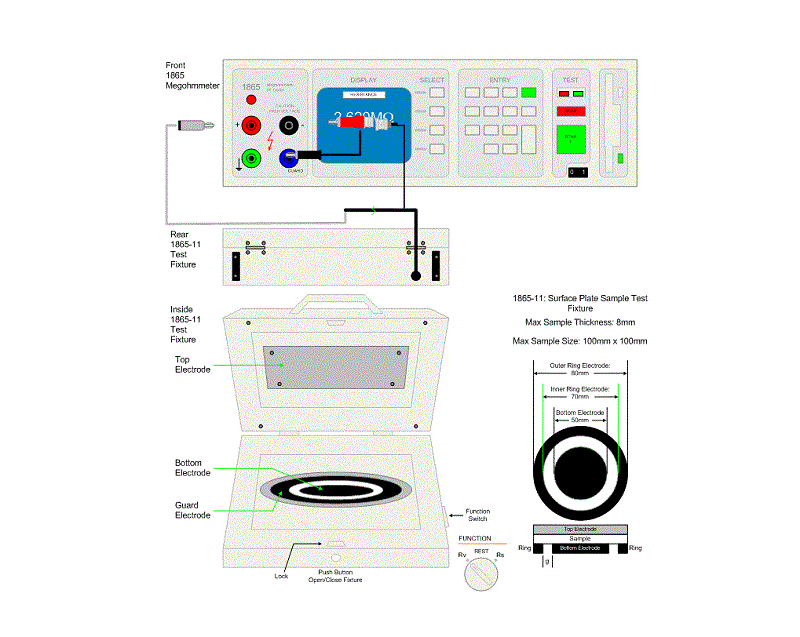
The 1888 Megohmmeter/High Resistance Meter can be used for measuring the resistivity of test samples as described by ASTM Standard D 257, which describes in detail the techniques for both surface and volume resistivity measurements. The 1888 Megohmmeter/High Resistance Meter in combination with the 1888-11 Resistivity Test Cell is shown in Figure 3-1. This combination makes a simple and easy to use solution for most volume and surface resistivity measurements.
The 1888 Megohmmeter/High Resistance Meter when used with the 1888-11 Resistivity Test Cell measures resistance and displays surface or volume resistivity. The 1888 has built-in Cell Constants for both surface and volume resistivity. These cell constants are factory programmed to the correct constants for the 1888-11 Resistivity Cell. The 1888 uses the measured resistance and cell constants to calculate the volume or surface resistivity of the sample. The thickness of the sample in cm does have to be entered into the Cell Constant Menu of the 1888 for correct volume resistivity measurements. No manual calculations are required to be performed by the operator or technician. The 1888 uses the same formulas to convert from measured resistance to resistivity as given in the ASTM D257 Standard. For the circular or concentric electrode configuration, the resistivity is calculated by:

Insulation resistance of materials is one of several parameters that may indicate the condition of insulation. An insulation test is to measure the resistance offered by the insulating members of a component part to an impressed direct voltage tending to produce a leakage of current through or on the surface of these members. There are times when knowledge of insulation resistance can be very important, for example; when resistance is high it may be the limiting factor in design of a high-impedance circuit, when resistance is low it can disturb the operation of circuits intended to be isolated. Insulation resistance measurements should not be considered the equivalent of a voltage breakdown test. Material with high insulation resistance could possess a mechanical fault that might fail during a voltage test and conversely material with low insulation resistance might not breakdown during a voltage test.
Factors that affect insulation resistance measurements include such things as temperature, humidity, previous conditioning, test voltage, charging current and duration of the test voltage (electrification time). It is characteristic of certain components (for example, capacitors or capacitive components or materials) for the current to fall from an instantaneous high value to a steady lower value, consequently the measured insulation resistance will increase from an appreciable time as test voltage is applied. Because of this it may take minutes to approach maximum insulation resistance readings, thus specifications usually require that readings be taken after a specified time, again electrification time. A routine test that has been widely adopted for insulation testing calls for the measurement of the apparent leakage resistance after a test voltage has been applied for 1 to 2 minutes.
AATCC 76-2000 Electrical Surface Resistivity of Fabrics covers test methods for the measurement of surface resistivity of various woven fabrics. This test method is applicable for resistivity measurements generally above 107Ω-cm or 107Ω (per square). See aatcc test method 76-2000 overview for more information.
See the ASTM D257 VIDEO on use of the legacy 1865 Plus and 1865-11. The 1865 Plus has been replaced by the NEW 1888 Megohmmeter/High Resistance Meter.
The link below is an application note on using the 1888 and 1888-11 for Resistivity Measurements. Resistivity Measurements using the 1888 Megohmmeter/High Resistance Meter and 1888-11 Resistivity Test Cell.
Below are several external links that provide additional information on ASTM (American Society for Testing and Materials) Standard D257 and IEC 62631-3-1.
Here is an example of a laboratory that uses the 1865 Megohmmeter to perform testing on polymer materials to ASTM D257 and IEC 60093. Intertek polymer labs provides testing to ASTM D257 and IEC 62631-3-1
Here is an article in Evaluation Engineering that compares ASTM D257 and EOS/ESD S11.11-1993. The Difference Between Surface Resistance and Surface Resistivity.