- Use with the 1888 Megohmmeter
- Designed to measure Surface and Volume Resistivity of a test sample
- Compliant with ASTM D 257
- Designed to measure Surface and Volume Resistivity of a test sample
- Compliant with ASTM D 257
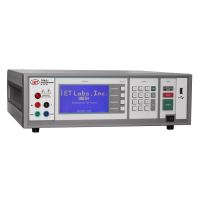
- Can be used with the 1888 Megohmmeter
- ASTM D 257 with 1865 Plus
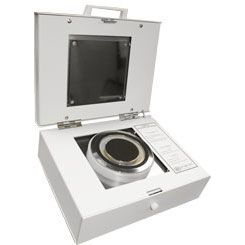
The 1888-11 is test fixture designed into a shielded case with hinged cover and interlock switch to reduce measurement errors and ensure operator safety. Designed to measure Surface and Volume Resistivity of a test sample as described in ASTM Standard D257-99.
The 1888-11 design uses a circular electrode configuration; Max sample thickness = 8mm. Min sample size 80 mm X 80 mm (3" x 3") and max sample size 100 mm x 100 mm (4" x 4").
The material must cover the outer guard ring which is 80 mm in diameter. The material cannot be so large as to touch the painted chassis of the 1888-11 which is 100 mm square.
Max. Temperature: 55 Deg. C
Max. Resistance that can be measured with the 1888 at 500 Vdc is 10 TΩ.
Volume resistivity represents an insulating material’s resistance through the material from one side to the other side.
The unit of volume resistivity is ohm*cm.
This should not be confused with the resistance displayed on the 1888 Megohmmeter which has units of ohms.
To determine volume resistivity the cell constant and thickness of the material must also be known in addition to the measured resistance. The cell constant and material thickness can be entered into the menu of the 1888. This allows for volume and surface resistivity to be displayed directly, when the display parameter is set to Volume or Surface Resistivity.
The 1888-11 has a volume resistivity cell constant of 19.6 (cm*cm).
So Volume Resistivity (Ω*cm) = 19.6 (cm*cm) * Measure Resistance (Ω) / thickness of the sample in (cm).
The 1888-11 when used with the 1888 permits measurements of volume resistivity up to 19.6 cm*cm * 10 x10^12 Ω / 0.1 cm, so (1.96 PΩ * cm).
This assumes a sample thickness of 0.1 cm and measured resistance of 10 TΩ.
Surface Resistivity
Surface resistivity is the resistance across the insulating material’s surface.
Surface Resistivity has units of ohms per square due to its more descriptive nature.
The 1888-11 has a surface resistivity cell constant of 18.8 / (cm*cm) where (cm * cm) is a square.
So Surface Resistivity (Ω/square) = 18.8 /sq. * Measure Resistance (Ω).
The 1888-11 when used with the 1888 permits measurements of surface resistivity up to 18.8 *10 x10^12 Ω/square (188 TΩ/square) assuming a measured resistance of 10 TΩ.
Note: Measured resistance values stated can be lower and vary depending upon environment.
The 1888-11 Test Cell measures resistance and with unique formulas, the resistance can be converted to surface and volume resistivity. The formulas required to convert from measured resistance to resistivity are given in the ASTM D257 Standard. For the circular concentric electrode configuration, the resistivity is calculated by:

Specifications:
Electrode Size: Diameter is 50mm and inner & outer dia. of ring electrode are 70mm & 80mm respectively.
Max Sample Size: Sample of 100mm square by up to 8mm in thickness
Min sample size: 80 mm square (3" sq.)
Max. temperature: 55C
Safety: Safety Interlock to disable voltage while the lid is open to ensure safety.